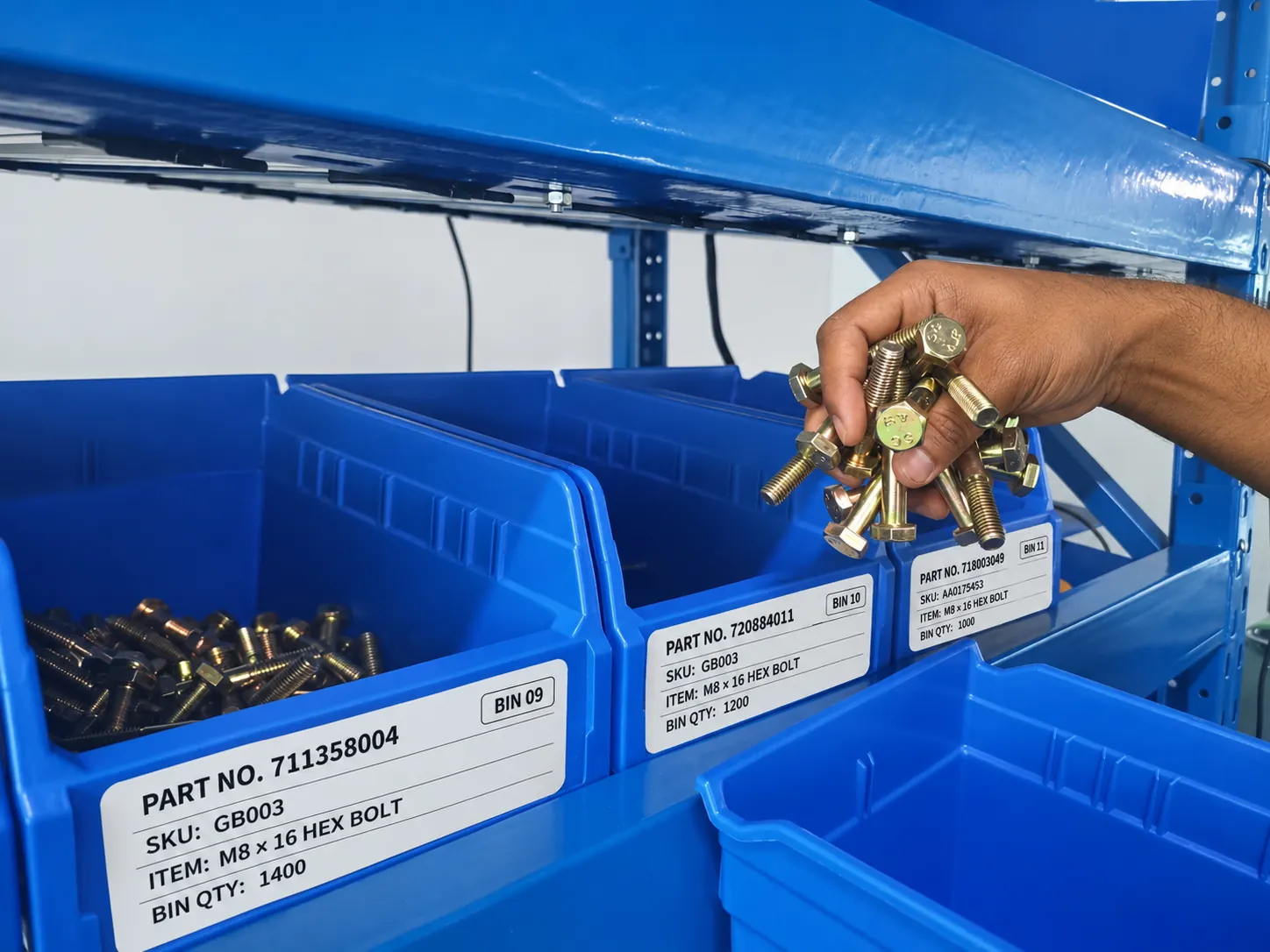
Ask any production supervisor what stops their line, and the answer is rarely a major breakdown. More often it’s something small: a bin of washers that ran dry, a missing clip, an empty tube of adhesive. Small parts are cheap, numerous and easy to overlook until they’re gone.
Why small parts run out
- Nobody counts them. Counting fasteners by hand is slow, so stock is judged by eye.
- Refill signals are manual. Kanban cards get lost or moved late.
- Consumption varies. A new product mix can double the usage of one part overnight.
- Line-side stock is spread out. Dozens of stations each hold their own bins.
How smart bins change this
A smart weighing bin sits on a load cell that measures its weight continuously. Because the system knows each part’s unit weight, it knows the quantity at every moment, and it sends a refill signal when stock reaches the reorder level you set.
- The operator takes parts as normal; nothing changes at the workstation.
- The bin’s quantity updates automatically.
- At the reorder point, the line feeder or stores team gets an alert.
- The refill is confirmed by the bin’s new weight.
What supervisors gain
- Refills arrive before a bin is empty, not after.
- Line feeders prioritise the bins that actually need refilling.
- Consumption by station and shift shows where usage has changed.
- Fewer emergency trips to stores in the middle of a shift.
Where to start
Pick one line, list the 20–30 parts that cause the most interruptions, and move them into smart bins first. The difference shows up quickly in fewer stoppages and fewer urgent refills.
See Smart Shelf & Weighing Bins and Manufacturing.