
FROM PRECISION BINS TO INDUSTRIAL PLATFORMS

Weighing Capacities & Configurations

The useful capacity of a smart shelf is chosen from what you store, how it is handled and which quantity changes need to be detected. The design can range from small fastener bins to reinforced heavy-duty racks and custom platforms.

Illustrative industrial cabinets and warehouse material storage
Illustrative technical diagram / application visualization

Maximum weight and smallest useful change must be designed together.

THE SYSTEM EXPLAINED

Match the storage position to the inventory

A single load-cell specification cannot describe every ERGO configuration. The complete support structure and item characteristics are part of the measurement.

01

Precision bins — small hardware and fine movements

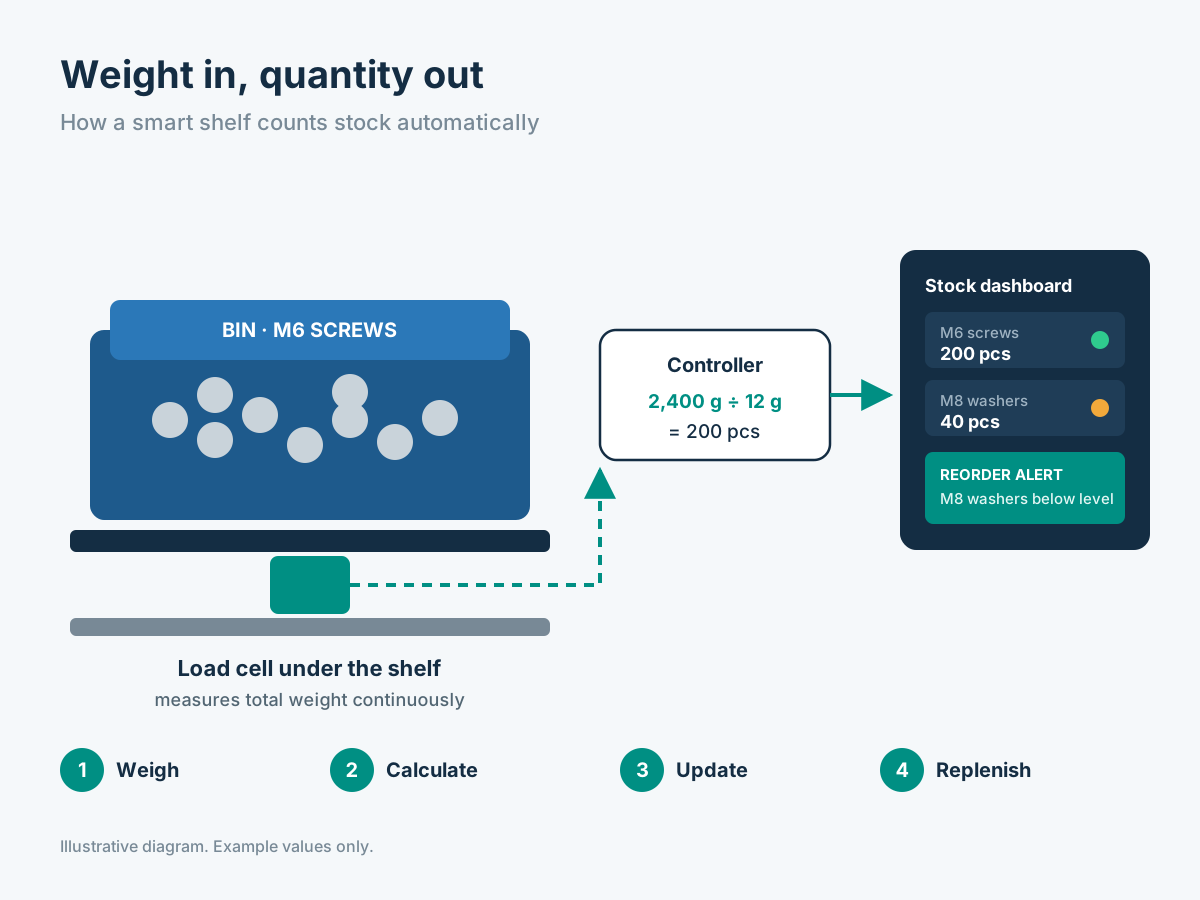
A precision bin can be configured for predictable fasteners, nuts, screws or light components. The selected sensor must carry the full bin and its container while still responding to the withdrawal quantity that matters. Unit-weight variation, packaging, bench vibration and the tare of the bin influence the outcome.

Before commissioning, representative items are weighed and compared against the calculated count at different fill levels. A separate SKU per measuring position helps keep readings interpretable. A small bin may be mounted on a workbench, a shelf module or an integrated line-side rack.
Precision bins — small hardware and fine movements
Illustrative
02

Light- and medium-duty shelves — consumables and spares

Light-duty positions can support cartons, boxed consumables, PPE and small maintenance materials. Medium-duty shelves may hold tooling, replacement components and larger spares. The structure, number of positions and total load distribution determine how the sensors are mounted.

Useful accuracy is defined in operational terms: can the position detect the removal of the smallest normal quantity while the shelf still contains the full intended stock? A pilot with representative handling conditions answers this more reliably than promising a universal sensitivity.

03

Heavy-duty racks and custom platforms

Large castings, motors, coils and drums may need reinforced supports, floor platforms or custom industrial assemblies. The chosen hardware should account for center of gravity, impact during loading, uneven placement, lifting equipment, overload protection and how staff replenish the position.

The monitoring objective may be item counting for known units, or measured material consumption where weight is the appropriate signal. The final range and achievable performance are defined by the completed mechanical and electronic system, not an isolated sensor catalogue.

Heavy-duty racks and custom platforms
Illustrative
04

The same inventory workflow across different loads

Once each measuring position reports a reliable stock value, the inventory application can organize light and heavy stock together under site, zone, rack and bin locations. Common reorder thresholds, reports and permissions help stores staff understand what needs replenishment.

Not every material is best counted by weight. When items are mixed, returned individually, serialized or variable in mass, the design can combine weighing with RFID item identification, barcode transactions or controlled access. Choosing the right method matters more than forcing one sensor type into every store.

TECHNOLOGY SELECTION

Configuration guide — from bins to platforms

These are application categories, not claimed numeric ratings. Engineering selects the detailed capacities and sensor assemblies.

ConfigurationTypical stored materialsEngineering emphasis
Precision weighing binsSmall consistent fasteners and electronics componentsTare, light-item sensitivity and separation
Light-duty smart shelvesPPE, packaging and standardized consumablesShelf load and container repeatability
Medium-duty shelvesMaintenance spares, tooling and boxed partsStructural deflection and meaningful withdrawal size
Heavy-duty racksLarge components and industrial stockOverload, stable mounting, safe handling
Custom weighing platformsOEM fixtures, drums and special-purpose storageMaterial handling, service access, integration
CONFIGURATION CHECKLIST

Five factors used to choose your setup

01

Full load

Total intended materials, container tare, platform and uneven placement.

02

Unit weight

Smallest relevant removal and consistency of the item or package.

03

Structure

Shelf stiffness, mounting arrangement, handling and vibration.

04

Environment

Temperature, moisture, contamination, electrical and service conditions.

05

Workflow

Refill method, user access, reporting and integration requirements.

Frequently asked questions

What is the maximum load of an ERGO smart shelf?

The available rating depends on the rack, sensor assembly and loading conditions selected for the project. Engineering can quote a tested model or design a suitable custom position.

How accurately can small components be counted?

A pilot with representative parts, typical fill levels and the actual mechanical setup establishes the useful counting performance. We do not infer an assembly specification from a load-cell data sheet alone.

MOVE FROM CONCEPT TO CONFIGURATION

We can help select the right smart inventory system.

Tell us about the items, users and locations involved. We can review the measuring positions, access workflow and replenishment requirements.

Request a Configuration →