When does weighing calculate inventory reliably? Understand item consistency, container tare, separated bins, sensor range and realistic exceptions.
The first condition: predictable unit weights
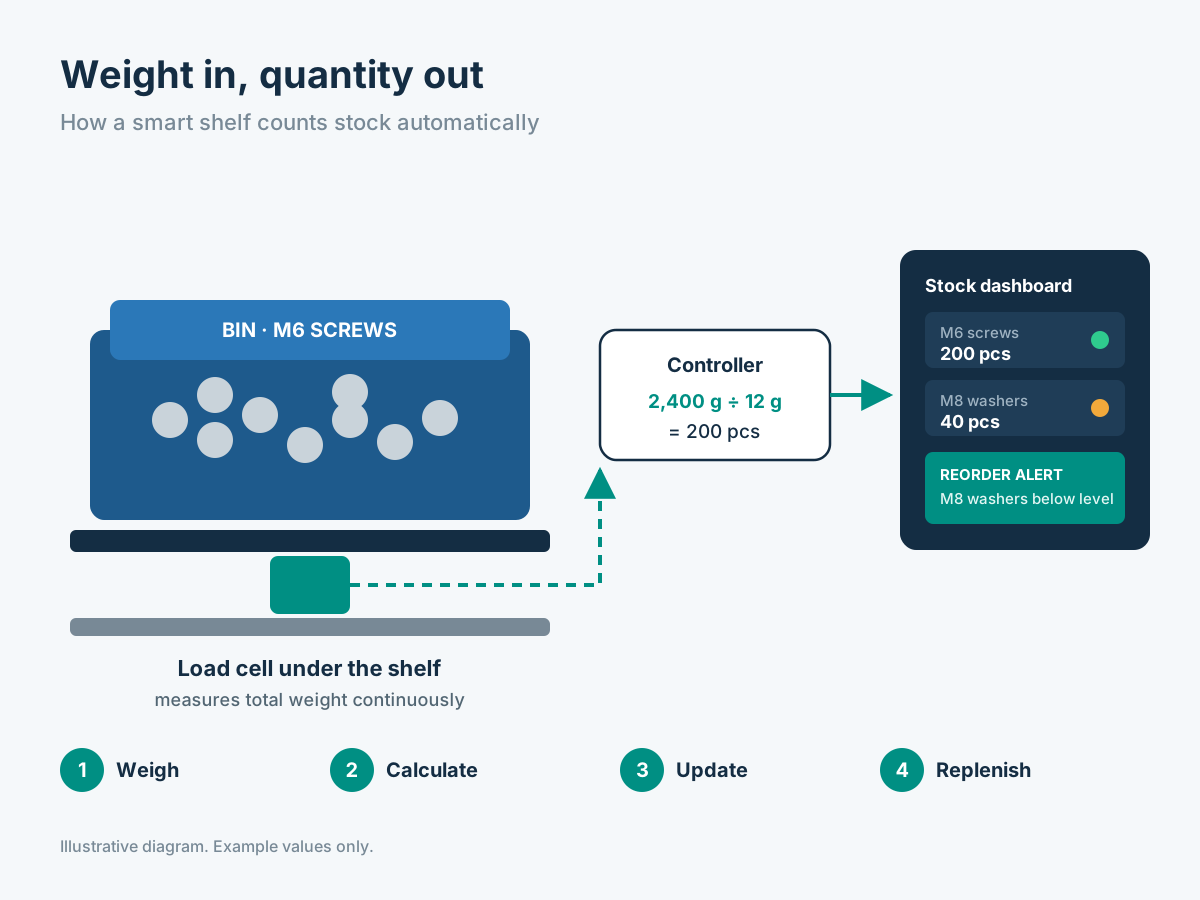
Weight-based counting works when a meaningful change in net load can be related to a known change in item quantity. A uniform steel fastener or sealed standard pack is often easier to monitor than irregular material with large unit-weight variation. The system subtracts the container tare and divides remaining net weight by a calibrated weight for that item. It then calculates a count for the configured position.
That calculated value should be tested against real items from the intended supplier and packaging. Part numbers that appear identical in a catalogue can still arrive with different labels, bags or pack weights. The right question is not whether a load cell is accurate in isolation, but whether the whole storage and counting arrangement gives an acceptable result for the operational task.
One SKU per measuring position keeps data interpretable
A shelf may physically hold a hundred different products, but a single sensor only sees the combined load. If a worker removes two washers and one bolt, the weight change does not automatically reveal which SKU moved. Separate bins or measuring plates give each known item an individual signal. The physical layout is therefore part of the data model.
When separation is impractical, the system may need a barcode confirmation, item-level RFID or a different transaction workflow. It is often better to redesign the bin arrangement than to apply increasingly complex assumptions to an ambiguous measurement. A pilot should explicitly list which positions contain single SKUs and which require another method, rather than allowing mixed stock to become an unexpected source of errors.
Consider empty container tare and packaging changes
The measuring position reads everything placed on it: stock, trays, liners, protective bags, stickers and sometimes dispensing hardware. A known empty-container tare allows the software to calculate net stock mass. If an operator replaces a lightweight plastic tray with a heavier one, however, the calculated quantity may shift without any actual change to the material.
Controls can include dedicated containers, a documented tare update process, checking packaging changes and training the refill staff. For some items, counting standard sealed packs is more stable than estimating individual pieces inside a variable package. The chosen approach should match how operators actually pick and restock, not a perfect container arrangement that only exists during a demonstration.
Match sensor range to full load and minimum removal
A smart bin may begin full and become nearly empty. Its sensor must support the heaviest normal load and still detect the smallest quantity movement that matters. The maximum load, empty container mass, unit weight and required count granularity form one design problem. Selecting the highest-capacity sensor is not necessarily helpful for detecting small items.
Resolution specified for an electronic sensor is not the same as verified counting repeatability on an installed shelf. Mechanical friction, mounting, electrical noise, vibration and calibration procedures all affect the final outcome. Ask the engineering team to demonstrate normal withdrawals and refills at several stock levels. Record the results for the smallest meaningful pick rather than advertising an unsupported universal accuracy figure.
A stable structure matters as much as electronics
The bin must transmit its supported load into the intended measuring elements. If it rests on a neighboring shelf rail, touches a back wall or is pulled off its support during picking, the measurement may temporarily change for reasons unrelated to actual stock. A stable mounting arrangement helps the system separate stock changes from everyday handling.
The physical test should include common events: opening and closing drawers, leaning near the shelf, refilling a heavy container, walking forklift traffic and moving adjacent stock. In some environments a controller may wait for measurements to settle before recording a change. The suitable signal filtering and mechanical design depend on that environment, and should be validated during commissioning.
Test item variation, batching and partial packs
A factory may receive the same nominal SKU from several approved suppliers. If the mass varies enough between lots, a unit weight calibrated on one batch may produce uncertainty on another. This is especially relevant when the item is extremely light or the bin holds many pieces. Sampling actual stock across likely variants helps establish whether weight-based counting is appropriate.
Partial packs create another complication. The operator may open a bag, discard a carton or move items between containers. Clear rules for item units and tare are essential. Sometimes the best strategy is to monitor sealed boxes or replenishment packs rather than individual loose items. The useful measurement level is the one that supports a real replenishment decision with acceptable reliability.
Choose an appropriate replenishment threshold
For many applications the stock count does not need to be perfect to improve operations. It needs to be accurate enough to flag a refill before the next assembly shift runs out. The appropriate threshold depends on consumption, replenishment lead time and the consequence of a shortage. A digital alert at the correct point can reduce unnecessary checks even where periodic physical verification continues.
Where the threshold is too low, a minor counting deviation can result in a late alert. Where it is too high, stores may refill too frequently and lose the expected efficiency. Pilot data should be reviewed with the people who refill the bins. Keep a clear separation between an alert, a proposed purchasing action and a fully verified ERP reorder integration.
Recognize the difference between quantity and identity
Weight tells the system that the net load changed at a known position. It does not inherently identify the person making the change. In a controlled cabinet, an employee RFID card or PIN can identify the session; the weight change during that authorized access may then be associated with the user. This requires a suitable lock and access workflow rather than merely installing an RFID sticker near a shelf.
For reusable tools the important record may be a specific identity and return status. A barcode transaction or item-level RFID is more appropriate than interpreting mass alone. The best tool crib therefore separates consumables counted by weight from returnables identified individually. Both may appear in one management view, but the data should state which method produced each record.
Use a pilot to expose exceptions before rollout
A representative pilot should include an empty bin, a typical full bin, several pick sizes and multiple refills. Compare calculated counts with physical quantities at planned checkpoints. Review what happens after a power interruption, controller restart, item-map change and container swap. A system that looks convincing during one controlled pick may behave differently across normal factory shifts.
Track exception types rather than averaging them away. Unexpected readings may come from mixed items, a stuck container, vibration, unusual packaging or a wiring problem. Assign an owner for reviewing and correcting these events. The acceptance criteria should include the intended reporting delay, useful count deviation, fault identification and reconciliation process appropriate to the materials.
Environment and compliance are project conditions
Precision bins in an electronics area may need ESD-compatible containers and grounding. Healthcare storage may need an approved cleaning process and restricted storage policies. Aerospace maintenance stores may require tool-accountability procedures and qualified records. Those requirements are not conferred by a weighing sensor or an attractive software interface.
An application design should document which environmental, electrical, security and regulatory requirements apply. The hardware can then be evaluated and built against the approved specification. Do not assume a company-wide certification or accuracy claim applies to every custom shelf, cabinet or platform. Final performance is established by testing the relevant assembly for the intended stock and environment.
Maintenance determines long-term counting quality
Smart inventory is not maintenance-free. A damaged bin, a shifted mounting point, a changed item unit weight or a faulty cable can make the displayed count unreliable. Clear ownership of calibration and item records helps keep the system useful. Technical staff should have a way to identify which measurement position needs attention without disrupting every other location.
Operator training can be simple but practical: put items back in their correct bins, use the approved container, report an unusual count and follow the defined refill process. The reporting tool should support that workflow rather than encourage blind trust in a number when the physical position has changed.
Decide when another technology is better
A highly mixed position, an irregular collection of reusable assets or a product with variable weight may not suit unit-weight counting. Barcode or RFID identification may then offer clearer transaction records, even though those methods have their own requirements and can depend on scanning or tag performance. The correct choice depends on what the operation needs to know.
Weight sensing often excels at everyday high-volume consumables held in known zones. Its value comes from reducing repeated manual checks and giving replenishment teams actionable signals. It works best when engineering considers the parts, storage, users and software together. An honest pilot should show both where weighing succeeds and which items should use a different approach.
Key considerations
- Consistent item weights and one known SKU per measurement zone are essential.
- Sensor capacity and the minimum meaningful stock change must be designed together.
- Test real stock, packaging and mechanical handling before approving the installation.
- Use RFID/barcodes where item identification is more important than weight-derived quantity.