Compare RFID cabinets, user access readers, item-tagging and weighing shelves for consumables, tools, transaction logs and controlled inventory.
Start with the question the cabinet must answer
A smart cabinet can secure stock, identify users, measure consumable quantities or record returnable tools. Those functions are different, even though they may all appear in the same enclosure. An RFID access card can answer who was authorized to open a door. A weighing shelf can answer how the load changed at a known item position. Item-level RFID may help identify which tagged asset is present or missing.
Before choosing hardware, write down the information the business needs. A factory using expensive cutting inserts may want a quantity count and user-wise consumption. A tool crib managing reusable torque tools may need a specific issue-and-return history. A secure stockroom may primarily need permissions and an audit trail. Each requirement points to a different sensing and control design.
RFID access control identifies the person
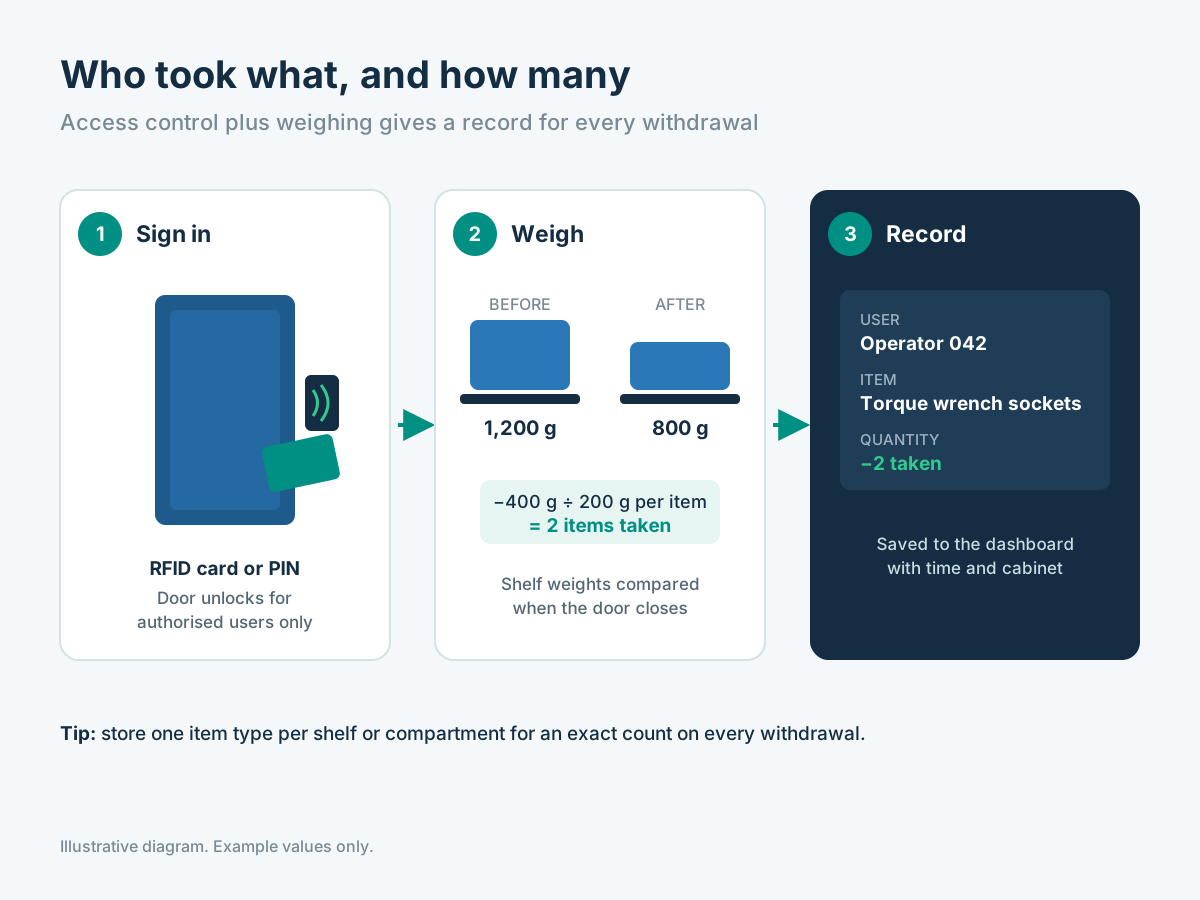
Many so-called RFID cabinets use an employee badge reader to authorize access. A credential is checked against the users and permissions configured for the cabinet. The lock then releases or the door opens according to the selected controller. A record can show the authorized user, access time and relevant door or session event.
That access record alone does not tell the system which materials were withdrawn. A user can open a cabinet, look inside and leave without taking anything. Several items can be removed during one session. To capture actual stock movement, the design needs weighing positions, individual item scans, suitable tagged-asset detection or another supported transaction process.
Item-level RFID is a separate tracking method
Another cabinet architecture puts compatible RFID tags on tools or other assets and reads those tags through designed antennas. The software may then detect identified returnable items when a drawer or cabinet is closed, depending on the controller, tag placement and reading geometry. This can support issue/return control for serialized tools without inferring their identity from weight.
Tag detection must be validated in the intended enclosure. Metal tools, dense arrangement, orientation and antenna coverage can affect performance. A claim that an RFID access badge works does not establish that every tool in the cabinet will be identified automatically. The buyer should ask to see the actual cabinet, intended tool set, reading workflow and exception process.
Barcode: low-cost scan-based identification
How it works: each item or location carries a printed barcode. A person scans it when stock moves.
Strengths: low cost, universal, well understood.
Limits: it depends on people scanning every movement; a missed scan means a wrong record. Items must be labelled, and scanning loose small parts is impractical.
Weight sensors, RFID and barcode compared
| Barcode | RFID | Weight sensors | |
|---|---|---|---|
| Needs a label/tag per item | Yes | Yes | No |
| Needs someone to scan | Yes | No (for tagged items) | No |
| Good for loose small parts | No | No | Yes |
| Identifies individual items | Yes | Yes | No (counts quantity) |
| Records quantity continuously | No | Partly | Yes |
Weighing positions calculate consumable quantities
A weighing cabinet uses calibrated load cells at designated shelves, trays or compartments. Each position is assigned a known SKU and unit weight. After subtracting container tare, the system calculates how much stock remains. This is well suited to standardized consumables such as cutting inserts, screws, safety supplies or other items whose mass is predictable.
Weighing also has boundaries. If a position holds different items of unequal weight, the combined change cannot reliably identify which part moved. The full stocked weight and minimum relevant withdrawal must be considered together when choosing sensors. Mechanical stability, calibration and container consistency should be demonstrated with the actual materials before purchase.
Combining user authentication with weighing
A secure cabinet can combine the two signals in a meaningful sequence. The user authenticates with an RFID badge or PIN, the controlled door or drawer opens, and stock is accessed. Weight readings before and after the authorized session can identify a quantity change in each dedicated measuring position. Software can then associate that measured change with the signed-in user.
The strength of this association depends on the access workflow. If several people can remove items while the same door is open, exact personal attribution may be uncertain. Items moved between bins or placed in the wrong location can also create misleading counts. Define user permissions and exclusive access where the application requires reliable person-linked stock records.
Returnable tools need distinct issue-and-return records
A reusable tool is not necessarily consumed when removed. A tool crib needs to know that it was issued to a person and later returned, perhaps with a job, work order or inspection status. Item-level RFID, barcode or confirmed kiosk transactions can support that workflow for tools with stable identities.
A weighing position may indicate that a tool's mass is absent, but it does not independently guarantee which serialized tool was removed if the location is mixed. A well-designed tool-management system can use weight for identical consumables and identification for returnables, reporting the different record types clearly. Avoid blending item consumption and outstanding-tool liability into one ambiguous stock figure.
Permissions, locks and emergency access
Controlled cabinets can be configured for authorized groups, different user roles, doors or compartments, and activity history. The chosen lock hardware determines how compartments open, whether access can be restricted independently and what happens during an outage. A badge reader does not by itself define the cabinet's power-failure or emergency-override behaviour.
Ask for lock-specific information, supported power options and a suitable physical-security review. Staff training should cover how an exception is reported, how an unauthorized attempt is handled and who can correct a user record. Security claims should be based on the actual enclosure and controller selected for the project, not on a generic statement that the cabinet is 'smart'.
Which approach suits small consumables and PPE?
Fasteners, inserts, drill bits, gloves and other consistent repeat items are often replenished as quantities rather than individually serialized assets. For these, a weighing zone can supply a useful calculated stock count and reorder signal. RFID or PIN access can add employee accountability when the items are valuable or need controlled issue.
Compartment-controlled dispensing is another option where the cabinet releases a specific compartment after authorization. That mechanism should not be confused with simply opening a general secure cabinet. A dispensing system can record the selected issue and support low-stock replenishment, provided the hardware, item geometry and transaction workflow are verified for the model.
Which approach suits high-value returnable tools?
Individually identified tools may be better tracked with tagged-asset RFID or barcode issue and return because the system must know exactly which tool is outstanding. A controlled drawer or cabinet can authorize the user and capture the relevant event. If more than one item shares a compartment, a count from total weight alone cannot necessarily distinguish them.
Where a tool has inspection, calibration or maintenance obligations, the external procedure must remain in place. An inventory cabinet can contribute transaction records but should not be assumed to provide regulatory approval or quality-system compliance. Define the asset identifiers, required return events and who reconciles exceptions before selecting a technology.
Questions to ask during a cabinet demonstration
Bring a representative set of materials, including the smallest usual pick and the heaviest loaded compartment. For weighing, ask to see a calibrated empty container, repeated withdrawals, returns, wrong-bin events and the resulting count. For item RFID, ask for repeated detection with the actual tools and their intended storage arrangement. For user access, test permissions, authorized and unauthorized sessions and how the log changes.
Also review what happens during power or network disruption, how the system identifies faults and how the site corrects inventory exceptions. Request written confirmation of installed model features, software modules, access methods and any claimed tests. This is more valuable than broad marketing promises that every cabinet automatically traces every item.
Use a hybrid design only where it adds value
A smart cabinet can be built for one purpose or combine several functions. Open stockrooms might need only monitored shelves; restricted consumables may justify weighing plus RFID/PIN access; returnable tool stores may need item identification and a kiosk; a PPE station may require dedicated dispensing compartments. Adding every technology to every shelf increases complexity without necessarily improving daily work.
Select a primary measurement or identification method per item type and define the supporting controls. Pilot the most demanding workflow with real operators, then agree the reporting and replenishment responsibilities. The best cabinet is the one whose records match what actually happens when staff remove, return and refill the stored materials.
Key considerations
- RFID employee access identifies the user; it does not independently count every withdrawn item.
- Item-level RFID detects compatible tagged assets when the antenna and workflow support it.
- Weight-derived counting is suited to known consumables in dedicated measured compartments.
- A hybrid cabinet can associate quantity changes with authenticated sessions, subject to controlled access and separation.