Load cells are the sensors that make weight-based inventory possible. You don’t need to be an engineer to use a smart shelf, but knowing how load cells work helps you choose the right system and set realistic expectations.
What is a load cell?
A load cell is a sensor that turns force (weight) into an electrical signal. Put a load on it, and it produces a signal proportional to that load. Read the signal with suitable electronics, and you have a weight measurement.
How a strain-gauge load cell works
Most load cells used in industrial weighing are strain-gauge load cells:
- A metal body bends slightly under load. The deformation is tiny and fully elastic, so the metal returns to shape when the load is removed.
- Strain gauges are bonded to the metal. A strain gauge is a thin foil pattern whose electrical resistance changes as it is stretched or compressed.
- The gauges form a Wheatstone bridge. Four gauges are wired in a bridge circuit, which turns very small resistance changes into a measurable voltage.
- Electronics amplify and convert the signal. An amplifier and analog-to-digital converter turn the voltage into a digital weight reading.
Common types of load cell
| Type | Typical use |
|---|---|
| Single-point (platform) | Under a shelf, tray or bin. Common in smart shelving |
| Shear beam | Platforms and heavier racks |
| S-type | Suspended or tension loads |
| Compression / canister | Very heavy loads |
The type is chosen to suit how the load sits and how much it weighs.
From weight to quantity
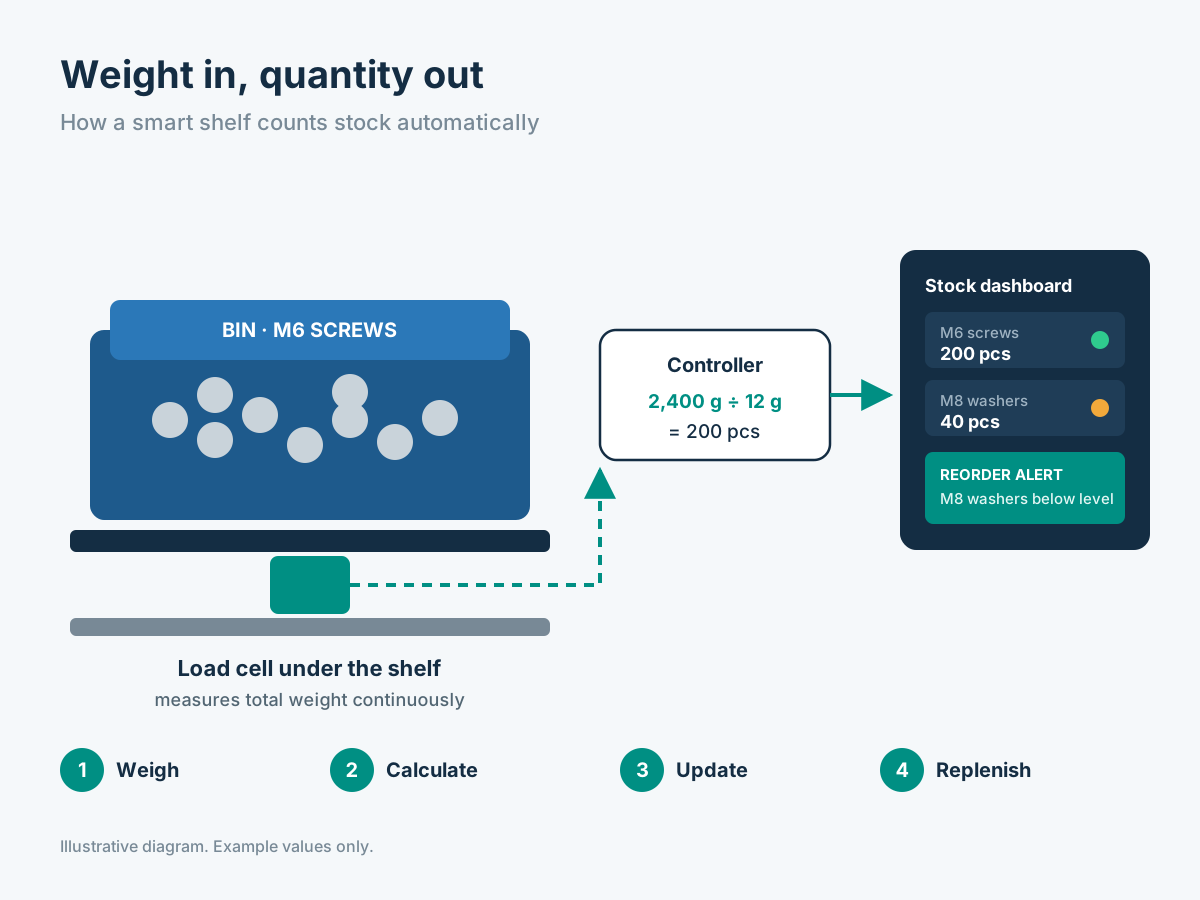
For inventory, the weight reading is only the start:
- Tare: the system subtracts the weight of the empty bin or tray.
- Unit weight: each item type has a known weight per piece or per pack.
- Quantity: net weight ÷ unit weight = quantity.
- Update: the quantity updates the stock record, and reorder levels are checked.
Illustrative technical diagram
What affects counting accuracy
- Item weight vs load cell capacity. Light items need a load cell sized for small loads. A sensor rated for heavy loads can’t resolve a single light part.
- Unit-weight consistency. Items that vary in weight (some cast parts, mixed packs) give less reliable counts.
- One item type per position. Mixed items in one bin can be weighed, but not counted reliably.
- Vibration and impact. Good electronics filter vibration, and installation matters.
- Calibration. Periodic checks keep readings trustworthy.
Questions to ask a supplier
- What is the lightest item each position can count?
- How is each position calibrated, and how often?
- How does the system handle vibration in my environment?
- Can capacity be configured per shelf or bin?
- How do readings reach the software, and how fast?
Learn more on our Load-Cell Technology and Weight Capacities pages.